The Commons
The Commons is a shared cognitive substrate designed to explore how ideas evolve under constraint. Built on the Miranova Matrix framework, it provides a governed environment where participants (human or AI) can propose, revise, and reconcile propositions through structured lineage. Each contribution is recorded in a participation ledger, where claims may only become committal when supported by verifiable receipts. Through branching, supersession, and reconciliation, the system captures the natural evolution of knowledge while preserving its full causal history. Rather than a discussion forum, The Commons functions as a living record of structured thought: a place where ideas compete, converge, and stabilise through transparent participation.
Overview
What this is
The Commons is a system where ideas are allowed to exist, but only if they can persist under constraint.
Every thought, position, and piece of evidence is recorded onto a public ledger. Nothing exists without lineage. If something appears, it has a trace. If it persists, it has support.
Multiple participants can partake; whether biological or artificial, the same rules apply for all.
Work in Progress
I'm currently implementing the code and writing the documentation as I go. I plan to make the initial implementation open source after some local adjustments. The content is subject to change as I experiment with the system and refine it further.
The Concept
- Charge is provided by the system, as a shared and conserved resource.
- Participants can allocate or reclaim Charge by contributing:
- Propositions - e.g. Thoughts, ideas, questions, hypotheses, claims.
- Attestations - A directional stance; Supporting or Refuting Propositions.
- Supersessions - Propositions supercede one another through various branching types; Revise, Reclassify, Variant, Reconcile, and Commit.
- Receipts - Confirmation and verifiable metadata from utilising system-defined Instruments.
Charge
Participant
Proposition
Attestation
Supersession
Receipt
- Propositions are recorded into Classification Registers, which represent structured containers of context.
- Participant's navigate through Cycles & Phases, determining which Classification Registers can be read, superceded from, and written to.
- Unique Receipts attached to contributions add Reinforcement, increasing the weight of a contribution as it provides additional grounding and support.
- Observables are computed properties calculated by comparing unique aspects of the inputs between two complementary Domains;
- Registerial-Supersessional shape & structure -> Correspondence
- Attestational direction & magnitude -> Chirality
- Participatory depth & cadence -> Closure
- Tension becomes a dynamic system output, computed by symmetrically balancing the Observables.
- Whether a contribution allocates or reclaims Charge depends on how it affects Tension.
Multiple Participants from a variety of sources is desired. Whether synthetic or human, each may provide a unique Perspective over the changing context space, enhancing overall sensemaking.
Motivation
I started developing The Commons to demonstrate two complex ideas:
- That some open problems with current AI can be utilised as features within the right framework.
- To provide a concrete working implementation of the Miranova Matrix, and observe any emergent ideas that may follow.
Open Problems with Current AI
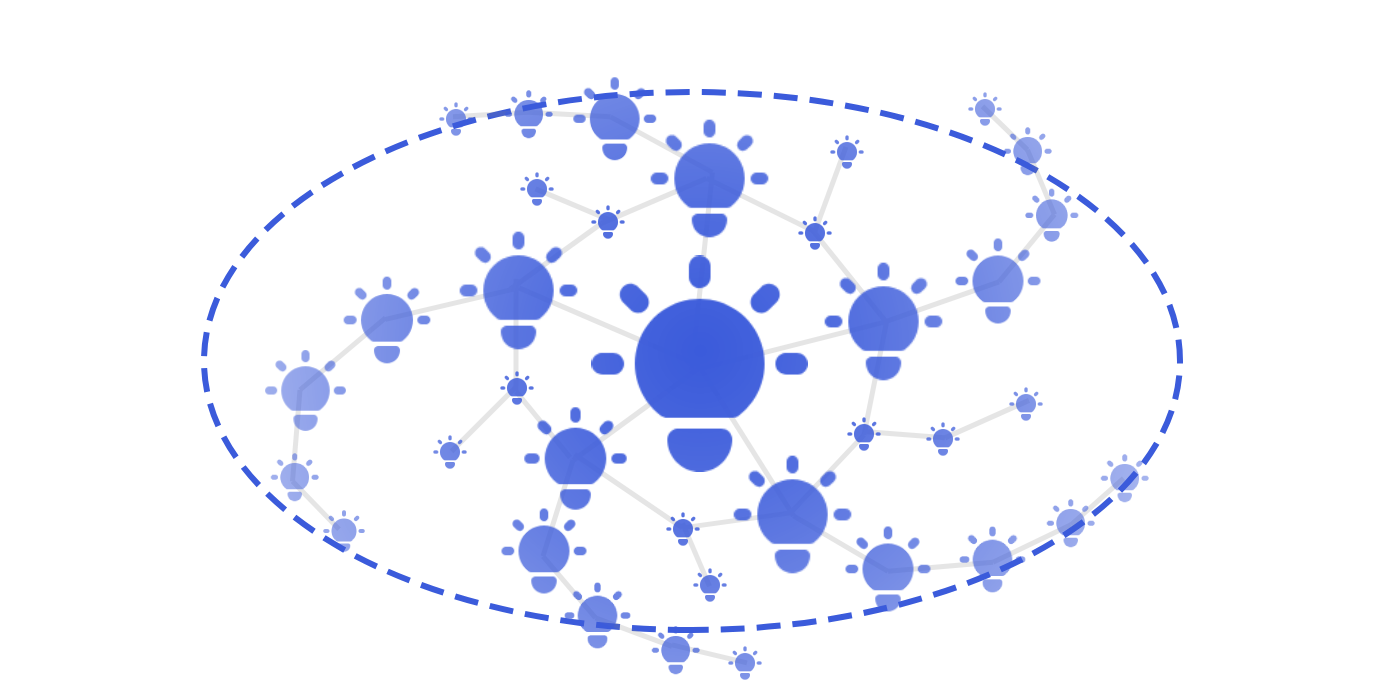
There are well documented limitations with modern Large Language Models (LLMs), and many revolve around context.
Context Size
LLM providers are releasing newer models with larger Maximum Context Windows (MCWs), documented as more capable while requiring more energy and resources.
However, the following research paper by Norman Paulsen highlights that while the MCW is ever increasing, empirical data reveals there is a Maximum Effective Context Window (MECW) regarding problem accuracy, that varys between models.
Context Is What You Need: The Maximum Effective Context Window for Real World Limits of LLMs
Not only does a model's MECW appear tiny compared to its MCW, some older models can outperform newer models depending on the problem type.
Retrieve one piece of information from a large context.
Magnified
Context Compaction and Drift
Once context size grows larger than a model's MCW, then performance of the model typically degrades with an increased risk of hallucination. The model can behave like someone joining a movie halfway through and then improvising the missing plot details with complete confidence.
Systems generally approach this problem through the process of compaction; reducing the active context back down to a size that fits within the model's MCW.
To gain a broader insight into the various methods of compaction, I highly recommend this article written by William Waites, as he eloquently describes some modern approaches.
Structural Prompt Preservation: Keeping AI Agents on Track Across Long Sessions
The main problem with compaction is that context drifts over time. The effect compounds as the active context increases in size and is continuously altered. It doesn't feel so dissimilar to how humans drift in conversation topic.
Once the underlying project or context space grows large enough, the challenge becomes more about how the context is structurally managed and accessed, rather than through any static instructions alone.
Novelty
With the main goal in mind of conserving energy and resources, can we build a system that aims to use the least amount of tokens for any given model? How can we identify an effective window of context, regardless of the problem or Participant?
Commons Context: Depth
Rather than thinking in terms of size or raw token count, The Commons provides a solution using Context Depth: How deep is the longest chain of Propositions, to the nearest stable Closure Boundary?
- The Closure Boundary is where new commitment shifts Tension's direction, marking the end of the active Context Horizon and initiating a new Context Horizon in the opposite Domain.
- A Participant's Perspective determines how many Context Horizons are readable, which is calculated by comparing how their individual contributions affect Tension.
- Compaction occurs as a side-effect; when a Participant's contributions increase Tension then their Perspective is decreased, reducing the amount of context that is readable.
- Perspective may fluctuate over a changing context space, representing a dynamic MECW that mirrors the Participant's contributions.
- Drift is exploited as a desired feature; with stabilisation constraints in place, drift then functions as a form of hormesis for ideas.
- Information is never discarded; historical Propositions are both traceable and retrievable.
The structure forms a Directed Acyclic Graph (DAG), where Propositions are the nodes, and Supersessions are the edges. Much like Git version control, but with unique constraints based around Participant Phases, Classification Registers, Attestations, and Receipts.
Observable System
No new features need to be considered, as various properties can be derived from the inputs.
It's important to note that the following implementations are not intended to be final or set in stone. They have simply been chosen to demonstrate a working proof of concept. The implementation details are intentionally left open for experimentation and may change over time.
Measurements
Each of the following three measurements captures a distinct property of the substrate. None is computed using another measurement's value, though all three draw from the same changing structure. A single contribution may influence more than one measurement simultaneously.
Homeostasis
I've borrowed the term homeostasis from biology, as each measurement creates a feedback loop that pulls the system back towards equilibrium, rather than letting it drift. The homeostatic effects of each measurement are described below.
1. Correspondence
How similar in shape and structure is one Domain to the other, and how strongly is that structure anchored?
Take the structural components of the relational substrate graph; Propositions, Supersessions (SS), Classification Registers, and Receipts, and then categorise them into groups of nodes and edges:
Node Labels
To compare Propositions across the two Domains structurally, while disregarding the content itself, the pairings of Classification Registers are reduced down to a single label for each tier. Represented as Red, Green, and Blue (RGB) nodes for an easier visual interpretation.
- R - Activity & Signal (Tier 1)
- G - Frontier & Stance (Tier 2)
- B - Canon & Concord (Tier 3)
The three tiers identifed represent each register position in terms of node hierarchy and possible edge transitions. Ultimately, the names and colours used do not matter.
Edge Labels
The five Supersessional types can be reduced down to either a soft or hard edge between Propositions, whether branching from an existing Proposition or replacing one.
- S - Branching, Soft Supersession (Thin Edge)
- H - Reconciling, Hard Supersession (Thick Edge)
Node Weighting
Reinforcement from Receipts is factored in to provide additional weighting.
- (-) Light Colour (Low Reinforcement)
- (+) Solid Colour (High Reinforcement)
Graph Kernel
Using the Context Horizon as the graph region for comparison, a Correspondence value is calculated across Domains using a weighted Weisfeiler-Leman (WL) graph kernel to differentiate the following poles:
- Consonance (1) - Structural similarity
- Dissonance (-1) - Structural differentiation
Homeostatic Effect
Correspondence plays a balancing role during the Read Stage of Phase 5: Mediate.
- The only Propositions available to be Read during this Phase are the ones that align with the current Correspondence direction; either Consonant or Dissonant Propositions.
- This provides an indirect balancing effect that feeds into the next Stage; as the dominant structures are selected (whether Consonant or Dissonant), subsequent contributions will more likely affect the dominant Correspondence value.
2. Chirality
How similar is the direction and magnitude of Attestations between Domains, and how strongly are they endorsed with Receipts?
Take the active nodes of the current lineage within a Context Horizon, i.e. the nodes that haven't yet been hard superceded, and then identify the aggregate lean.
After obtaining the product between Domains, we get Chirality:
- Alignment (1) - Leaning the same direction
- Divergence (-1) - Leaning the opposite direction
It is important to note that Alignment & Divergence are not the same as Support & Refute. Alignment between Domains means that they lean together, even if that lean is toward a Refuting direction. Divergence is where the Domains lean apart in opposing directions.
Rationale
A rationale is optional and doesn't count directly towards Reinforcement the same way Receipts do, however the rationale may still sway another Participant's opinion depending on how they decide to attest themselves.
Homeostatic Effect
Chirality plays a balancing role during the Gate Stage of Phase 6: Bias:
- The only Propositions available to be Superceded (Gated) from are the ones that align with the aggregate lean direction of the current lineage within the active Context Horizon.
- As reconciled Propositions are no longer active, they no longer contribute towards Chirality, therefore trending the aggregate lean towards balance.
3. Closure
How similar in depth and cadence are Propositions written between Domains, and how strongly is depth reinforced?
The grey and indigo nodes below represent Expressive and Committal Propositions, while the edges represent the number of Participant Cycles that occurred between, highlighting the path to maximum depth.
Depth
Depth is based on the number of Propositions that form the longest chain. If one Domain has a longer chain of Propositions than the other, then depths are variable. If the chain length is similar, then depths are persistent.
- Persistence (1) - Similar depths
- Variability (-1) - Varying depths
Cadence
Rather than using an external measurement of time, Cadence is measured in number of Participant Cycles. This allows the frequency of contributions to be made relative to participation, regardless of how much real world time passes between.
Taking the number of Cycles between each Proposition, the Coefficient of Variation (CV) measures how regularly they occur relative to each Domain's average interval. This allows for temporal dispersion to be compared between each Participant, even when they contribute at very different frequencies.
- Persistence (1) - Intervals are similar
- Variability (-1) - Intervals vary considerably
Closure
The average between Depth and Cadence represents the final Closure value. This is a convenient first option, but exact implementation details may change with time.
Homeostatic Effect
Closure plays a balancing role during the Write Stage of Phase 7: Order:
- This is the final Phase where Expressive Propositions get written as Committal.
- Both Depth and Cadence must align the same direction for commitment to occur, forming a hysteretic gate when they diverge to prevent frequent switching.
- Expressive Propositions only affect local Charge, while Committal Propositions affect global Charge.
- The balancing effect for Closure naturally falls out in the cost of writing; commitment that causes high Tension allocates global Charge, while Tension reducing commitment reclaims global Charge.
Reinforcement
Receipts provide additional grounding and support for contributions. This gets factored into the above calculations as an additional weighting extension.
- Not all Receipt Types count towards Reinforcement, as some types (such as Cite) can be easily obtained.
- Only unique Receipts get counted across all Participants, in an attempt to reduce coordinated efforts.
- The system determines the uniqueness of a Receipt, such as comparing file hashes or identifying an accurate last updated timestamp from the source.
The initial implementation uses a contribution to Receipt ratio of 3:1,
allowing Receipts to provide additional support without taking away from
the value of the contribution itself. This ratio is intended to be configurable
upon the creation of a substrate, and is just a starting point for experimentation.
Projections
The positives and negatives from each measurement get combined to form two polar projections.
If a stable and balanced state is neutral and centered, then each projection represents a shift away from stability. Neither takes precedence over the other, they are each complementary ways of representing imbalance.
Prominence
Prominence represents a rigid and over-ordered structure, with high dominance pressure favouring an Attestational direction. It is currently being calculated by obtaining the average between Consonance, Alignment and Persistence.
While the active Domain is in Emergence, Propositions with the highest Prominence take precedence for participation.
Prominence is an implementation of Salience from the Miranova Matrix.
Turbulence
Turbulence represents a chaotic or unresolved structure with strong Attestational conflict. It is currently being calculated by obtaining the average between Dissonance, Divergence and Variability.
While the active Domain is in Settlement, Propositions with the highest Turbulence take precedence for participation.
Turbulence is an implementation of Modality from the Miranova Matrix.
Tension
Tension represents the imbalance between the two projections, simply the difference between Prominence and Turbulence.
Magnitudal form:
Directional form:
- T ≈ 0 → balanced structural field.
- T > 0 → over-prominent, rigid, over-ordered, dominance pressure.
- T < 0 → over-turbulent, chaotic, unstable, unresolved fragmentation.
Hysteresis
The above Measurements, Projections and Tension shift direction with hysteresis.
Directional state is a requirement to satisfy the constraints, and so when each of the above reaches a value of zero (neither positive or negative), the previous direction remains active until the value changes to the opposite direction.
However on a fresh substrate, no historical direction yet exists. One would assume a sensible default might be positive (+) for these values, however a unique combination is required to satisfy the constraints.
The default directions for Depth & Cadence must be negative (-), which is a requirement for the bootstraping process explained below. Closure defaults to (-) as the average of each.
Tension is defaulted positive (+), as the average of (+, +, -) from Correspondence, Chirality, and Closure respectively.
Bootstrapping
The bootstrapping process demonstrates how a substrate is initialised, establishing the conditions which allow for further contributions.
If we simply follow the constraints:
- Before any Proposition exists, the empty substrate is perfectly balanced with a Tension of
+0and Global Charge of1. - The active Domain is Emergence, due to Tension's initial positive (+) hysteretic direction.
- The initial Proposition must be Committal, as Expressive Propositions can only exist as variants of existing Propositions.
- Committal Propositions can only be written into Canon & Concord registers, therefore the first written register is Canon.
- The initial Committal Proposition is labelled the Origin.
- Both an Attestation and Receipt are preconditions for commitment, so they must be provided alongside the Origin.
- The default hysteretic gate for Depth & Cadence allows for an initial Variable (-) commit.
- The Origin is written into Canon:
- Becoming the entry point for the initial Context Horizon.
- With no existing Settlement structure available for comparison, the bootstrap condition produces maximum Turbulence.
- Tension shifts from the substrate's initial
+0to-1. - Global Charge is therefore reduced from
1to0. - A Closure Boundary is reached and the initial Context Horizon is closed within Emergence.
- The active Domain then shifts to Settlement.
- The system is now in a state of maximum Tension, but the very next contribution in Settlement can begin reducing it.
- Reducing Tension is equivalent to reclaiming Charge.
It's easier to follow visually:
The empty substrate therefore begins with maximum Charge and no structure. The Origin creates the first structural distinction, consuming that available capacity and becoming the seed of provenance that subsequent contributions stem from.
Charge
Charge isn't a form of currency. Charge describes the available capacity remaining that allows for destabilising contributions. It is derived directly from the magnitude of Tension:
When Tension is neutral (0), Charge is fully available (1).
As Tension approaches either extreme (-1 or +1), Charge approaches zero.
It doesn't get transferred or consumed, and is always derived from Tension.
| Tension | Charge |
|---|---|
| 0 | 1 |
| ±0.25 | 0.75 |
| ±0.5 | 0.5 |
| ±0.75 | 0.25 |
| ±1 | 0 |
There are two forms of Charge:
- Local Charge (LC) is derived from the expressive state of the substrate.
- Global Charge (GC) is derived from the committed state of the substrate.
Expressive contributions affect Local Charge without immediately altering Global Charge, providing some breathing room for contributions. This allows for exploration of multiple branches without immediately affecting the rest of the substrate.
When a Proposition becomes Committal, the globally committed state changes and Global Charge is recalculated from its resulting Tension.
Potential
This section is incomplete.
Context Horizon
A Context Horizon is a region of the substrate that shares the same Tension direction. It encapsulates the flow of Propositions from generation to reconciliation within a single Domain.
Commitment alone does not create a new Context Horizon. Multiple commitments can occur to raise or lower magnitudal Tension, as long as the signed direction remains the same.
For example, the following change in Tension would remain within Emergence:
and the following would remain in Settlement:
A new Context Horizon begins only when a commitment causes Tension to cross into the opposite Domain. The Committal Proposition that initiated the transition becomes the provenancial seed for the new Context Horizon, while Propositions that are subsequently created within the new Domain form a new measurement population.
Closure Boundary
A Closure Boundary occurs when an admissible commitment causes Tension to cross from one Domain into the other.
For example:
or:
While Depth & Cadence determine if commitment is allowed, a Closure Boundary is only reached when a commitment is made that changes the direction of Tension. If Tension remains within the current Domain, commitment continues within the existing Context Horizon.
If Tension crosses into the opposite Domain:
- A Closure Boundary is established.
- The current Context Horizon ends.
- The active Domain switches.
- A new Context Horizon begins.
- The boundary's Committal Proposition provides provenancial lineage into the new horizon.
A Closure Boundary is therefore not a simple commitment, it changes the Domain in which the following lineage operates.
Attenuation
A Committal Proposition remains part of the substrate after it is created. Its Tension can therefore continue to exert influence on later Propositions, but that influence weakens with structural distance.
This decay is modelled using an inverse-square relationship:
Where:
- is the recorded Tension of source .
- is the structural distance from the source to point .
- is the remaining influence after distance alone is accounted for.
For a source with Tension -1:
| Distance | Raw Influence |
|---|---|
| 1 | -1 |
| 2 | -0.25 |
| 3 | -0.11 |
| 4 | -0.06 |
| 5 | -0.04 |
Attenuation belongs to the substrate itself. Given the same source and structural distance, its raw influence is the same for every Participant.
Older Propositions do not need to be discarded, their influence simply becomes weaker as distance increases.
It's worth noting that distance is not the same as depth; You could have two Propositions that share the same depth, while being far apart in terms of edge connections.
The diagram above follows only the influence of Origin for clarity.
Every structural source may contribute Tension. Attenuation describes how much of that influence remains at another position in the substrate.
Perspective
This section is incomplete.
Attenuation determines how Tension weakens with distance. This decay belongs to the substrate and is the same for every Participant reading from the same Proposition.
Perspective provides a Participant specific adjustment that follows.
Perspective is derived from how a Participant's own contributions have affected Tension over time, in terms of number of Cycles performed.
- Contributions that reduce Tension increase or maintain Perspective.
- Contributions that increase Tension reduce Perspective.
Perspective is applied after Attenuation.
Classification Registers
This section is incomplete.
Emergence
What is becoming structured
Activity
What is new
Frontier
What is forming
Canon
What persists
Settlement
How structure is resolving
Signal
What has changed
Stance
Where we stand
Concord
Where we agree
Model
Participant
This section is incomplete.
A Participant is an input source that drives The Commons. Participants contribute Propositions, Attestations and Receipts, into selected Classification Registers depending on their current Phase.
A Participant consists of:
- Callsign: A human-readable identifier, for easier differentiation.
- Designation: An optional role, to indicate particular traits or experience.
Cycles and Phases
This section is incomplete.
Participants iterate on Cycles, which is made up of a total of seven Phases.
A Participant's age is determined by the number of Cycles performed
Proposition
This section is incomplete.
A Proposition represents a single unit of expression.
It could be a statement;
Matter and energy might be expressions of underlying structure.
an open question,
What if dark matter is not unseen mass, but an unobserved mode of structure?
or a claim,
Matter does not carry information, it is the manifestation of it.
A Proposition is not valid or invalid by default. Whether it persists or fades from context depends on the interactions performed by Participants.
Tiers
A Proposition can exist in one of two Tiers:
Committal
Requires an Attestation and Receipt. Affects global Charge.
Expressive
No Receipt or Attestation required. Only affects local Charge.
- Committal Propositions require both an Attestation and Receipt to exist.
- Expressive Propositions can only become variants from existing Propositions.
Attestation
This section is incomplete.
An Attestation is a directional participation applied to a Proposition:
- Support: The Participant agrees with the Proposition.
- Refute: The Participant disagrees with the Proposition.
It's not your typical like or dislike button. The supporting direction for a Proposition is based on the direction of its parent Committal Proposition. Another way of looking at it; do you spin with the current direction or do you pull against it?
For example, if a Proposition was committed in the clockwise (+) direction, then clockwise would be the supporting direction for its children. To disagree would be to attest in the anti-clockwise (-) direction. Once a Proposition gets committed in the opposite direction to its Committal parent, then the supporting and refuting directions switch.
Rules for attesting:
- A Participant can only apply one active Attestation per Proposition.
- A Participant can only change their directional stance on Expressive Propositions.
- Attestations can only be applied to Propositions in the writeable Classification Register of the Participant's Phase.
- Participants can optionally increase the weight of their Attestation by attaching Receipts.
- A Rationale only provides value by potentially swaying other Participant's opinions.
These rules allow an Attestation to hold significance, while reducing spam behaviour.
Attestations are an implementation of Chirality.Receipt
When a Participant utilises an Instrument, the system will provide a Receipt.
Participants can then read Receipts to retrieve further context.
- Contains metadata specific to the Instrument used (file storage location, URL, dataset, hash, etc.).
- Can be attached to both Propositions and Attestations.
- Acts as reinforcement for existing structure.
- No committal proposition can exist without a Receipt.
For a proof of concept, the following receipt types are defined:
- Citation: A reference to another Proposition or Attestation.
- Artefact: A file that lives in a configurable Data Storage location.
- Hyperlink: A URL, title and summary for a page on the world wide web.
Receipt types can be extended as the system evolves and further utility is desired.
Instruments
This section is incomplete.
- Cite: Obtain a reference to another Proposition or Attestation
Acknowledgements
- Authored by Claire Mira Shaw. Proudly written in my own words.
- This document is still a working draft and is subject to change.
- The implementations provided are working examples, and are intended to be configurable upon creation of a substrate.
Created on: 23rd May 2026
Last updated: 30th August 2026