
The Miranova Matrix
The Miranova Matrix is an operational framework for studying how persistent structure may arise from minimal irreversible update rules. System progression is modelled as discrete “Ticks”: closed traversals in which defined Degrees of Freedom are read, gated, and written under admissibility constraints. The resulting Participation Ledger specifies a minimal grammar through which commitment, compatibility, directional bias, and closure can be expressed without presupposing geometry or external time. Miranova is presented not as a physical theory, but as a simulation-oriented formalism for exploring constraint propagation and emergent organisation under physically compatible principles.
Introduction
Many modern ideas in science suggest that space, time, and lasting structure may not be fundamental ingredients, but patterns that emerge from deeper processes. Rather than beginning with spacetime as a given stage, one can ask a simpler question:
What is the smallest kind of update a system must perform for persistence and complexity to arise at all?
This work explores that question through a minimal operational lens. Instead of starting with geometry or equations of motion, it begins with discrete irreversible steps; “ticks”, that distinguish, transform, and regulate state. Over repeated cycles, such updates can stabilise structure: regions of compatibility, constraint, and ordered persistence.
The Miranova Matrix is not proposed as a new physical theory, but as a simulation-oriented grammar for emergence; a structured way to explore how commitment and constraint can generate durable regimes over time. References to physical notions such as causality or irreversibility are used only as interpretive guardrails. The colour mappings used throughout are introduced as an operational representation; one possible way of encoding the framework's participating degrees of freedom for clarity and eventual simulation, rather than as claims about fundamental properties of nature.

Operational and matrix-based formulations appear widely across physics and computation as compact representations of relational structure and irreversible transformations. Motivated by emergence programs in contemporary physics and complex systems, this work asks whether a minimal cycle of distinctions and transformations can serve as a useful operational basis for studying persistent structure under physically compatible constraints.
Conventional descriptions typically begin by assuming geometric or continuum structure. By contrast, the Miranova framework treats ordered update operations as primary, allowing persistence, causal depth, and structural regularities to arise from constraint-mediated update dynamics rather than being imposed as background. The result is a self-contained ledger of participation, intended for simulation, through which one may explore how constrained structure stabilises, how incompatibilities produce strain, and how ordered regimes emerge through mediated admissibility.
Motivation
The Miranova Matrix is presented as an operational grammar for emergent structure, specified independently of any particular physical theory. Nevertheless, it is useful to motivate the framework using familiar phenomenological patterns: the kinds of stable structure that embedded observers already encounter, and the possibility that such structure reflects deeper informational constraint. The interpretive references that appear throughout this work are therefore not intended as derivations, but as orienting analogies: observational guardrails that help frame why a minimal operational ledger may be of interest.
Particle Phenomenology as Emergent Artifact
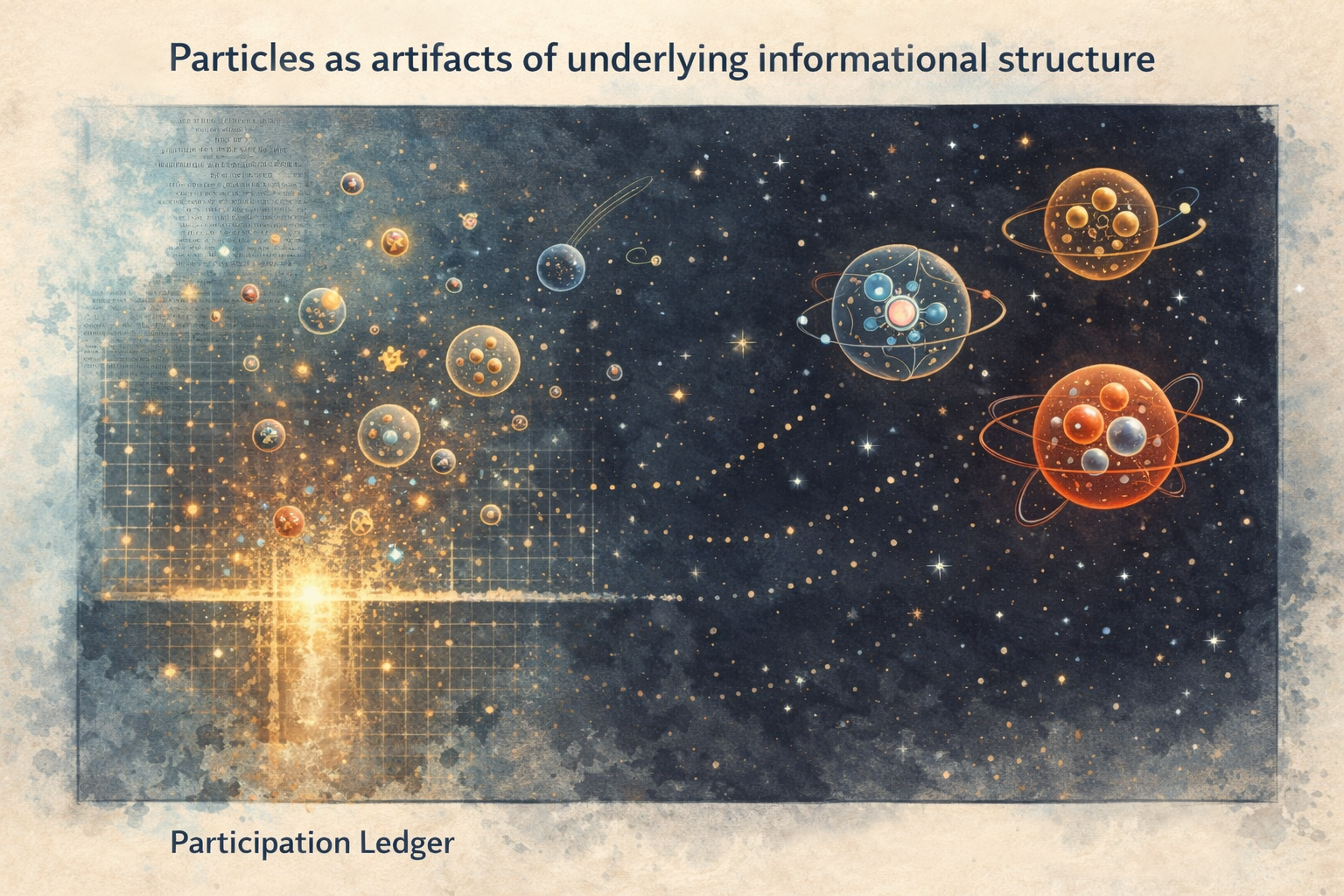
In an emergent spacetime setting, particle-like entities need not correspond to fundamental objects. They may instead arise as stable, repeatable artifacts of deeper operational constraint organisation: persistent modes of admissible commitment that appear as localised excitations to embedded observers.
The Standard Model is referenced throughout this work not as a derivation target, but as an observational catalogue of the most refined emergent regularities currently accessible. Its role here is exploratory: if the phenomena we call “particles” reflect structured artifacts of an underlying informational substrate, then existing particle phenomenology may offer a principled guide toward the number and character of degrees of freedom required for minimal operational emergence.
This interpretive perspective served as the original motivation for constructing the present operational framework.
Structure as Fruiting from Constraint Networks
A second motivation comes from the broader observation that visible structure often represents only the surface expression of deeper generative organisation. In biological systems, flowers emerge from root networks, and mushrooms fruit from extended mycelial substrates. What appears at the surface is not a primitive origin, but a localised manifestation of an underlying connectivity and constraint field.
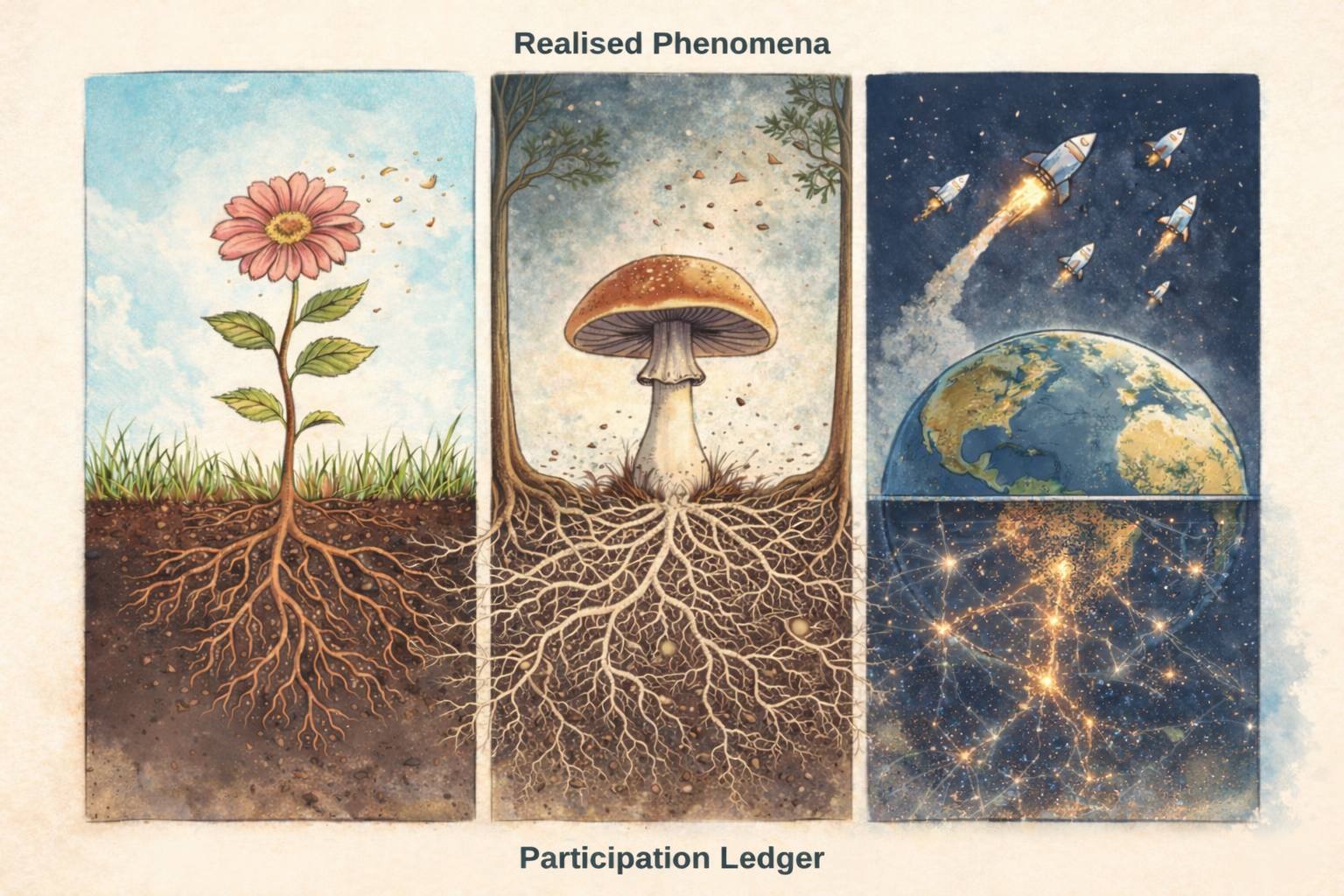
This work treats ordered structure in a similar way; not as an assumed geometric background, but as something that may arise through patterns of admissible participation. The Participation Ledger provides a compact operational record of such participation, specifying how degrees of freedom are read, gated, and written across update events. Persistent “objects” may then be understood as stabilised configurations within this ledger, rather than as fundamental constituents.
Transition to the Operational Framework
With these interpretive motivations in view, the remainder of the paper proceeds by specifying the minimal operational registers and update grammar required for emergent structure in simulation-oriented form: the nine Degrees of Freedom, the Tick primitive, and the seven operations through which commitment is traversed.
Operational Framework
Core Primitives
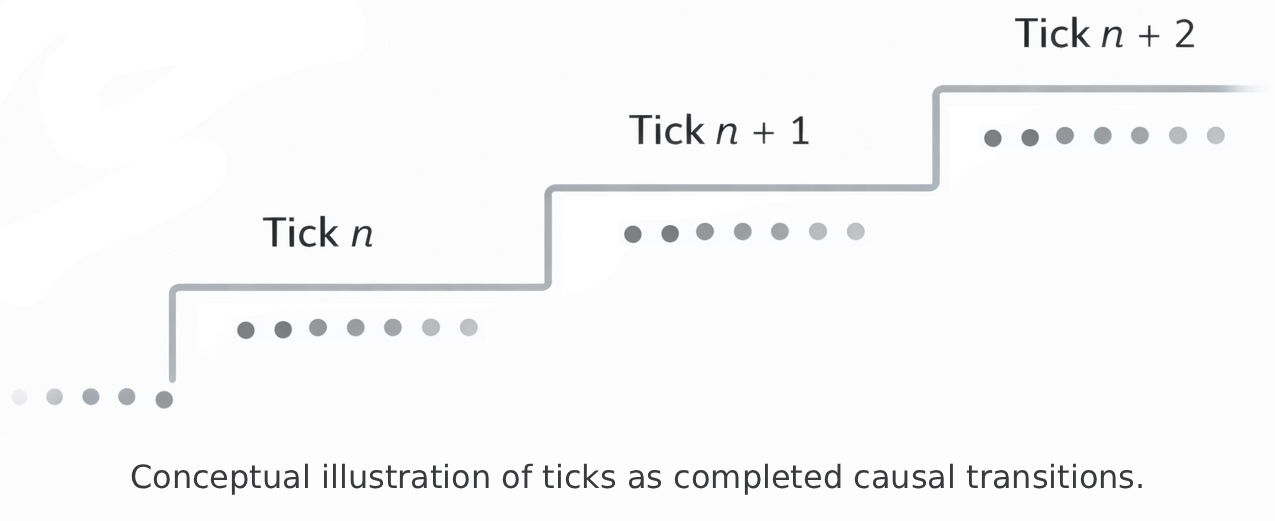
- Tick A tick is a minimal irreversible system update in which operational changes accumulate, independent of external time. In simulation, ticks may be realised as asynchronous local commitment events.
- Identity / Distinction Identity is the persistence of a distinguishable structure across one or more ticks. Identities emerge when distinguishable patterns remain correlated across successive updates.
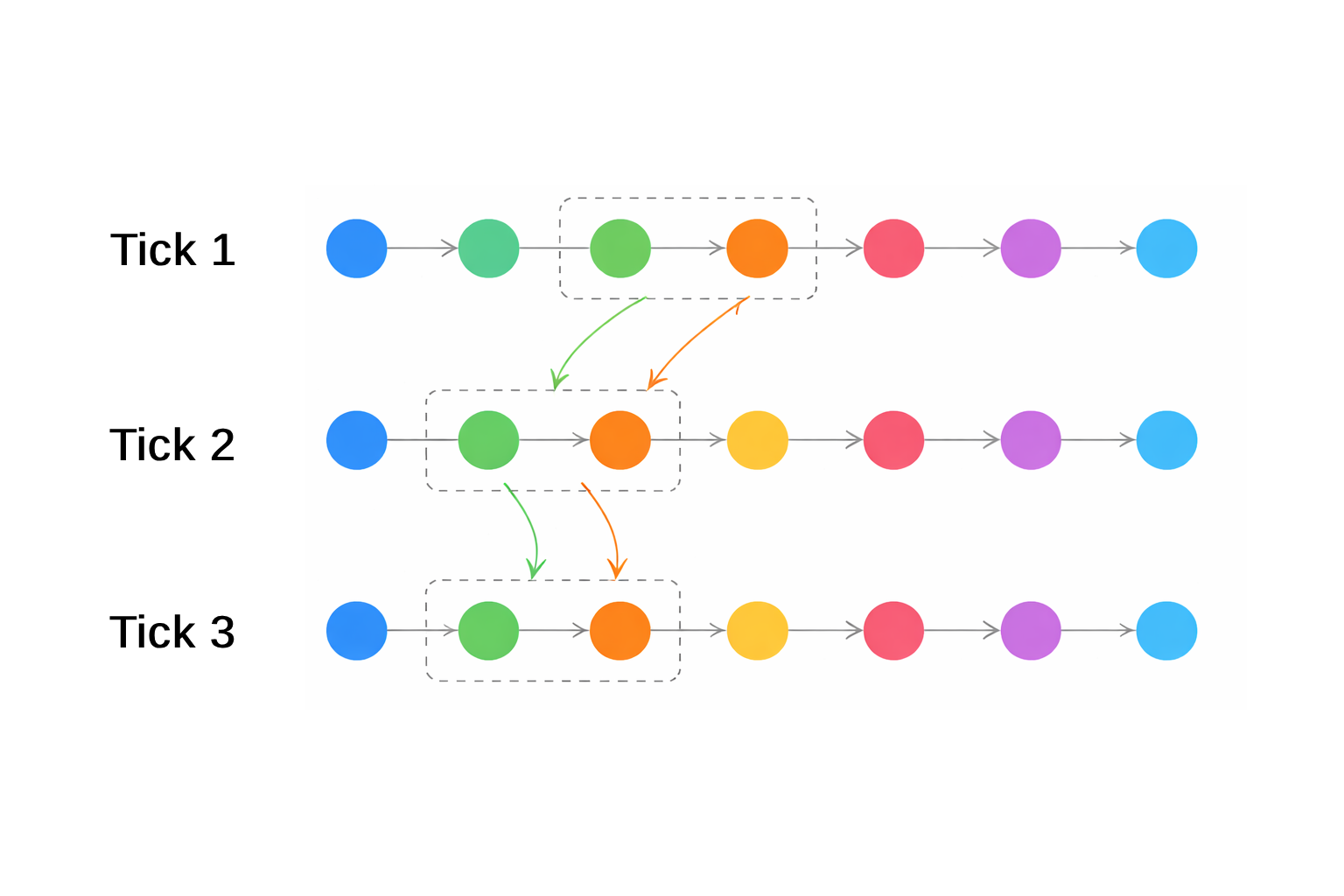
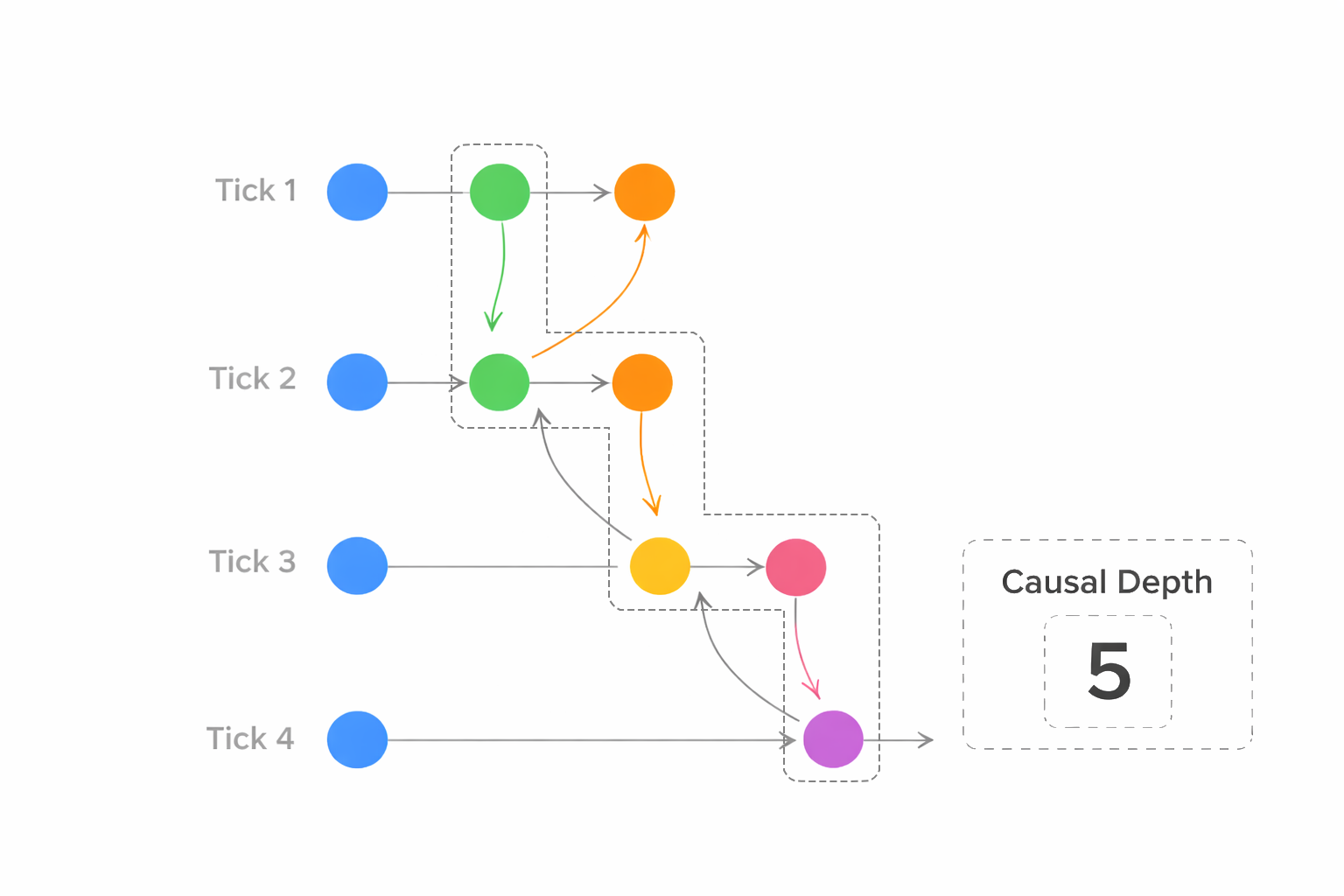
- Causal depth Causal depth is the length of the longest irreducible chain of tick-ordered dependencies required for a structure to exist.
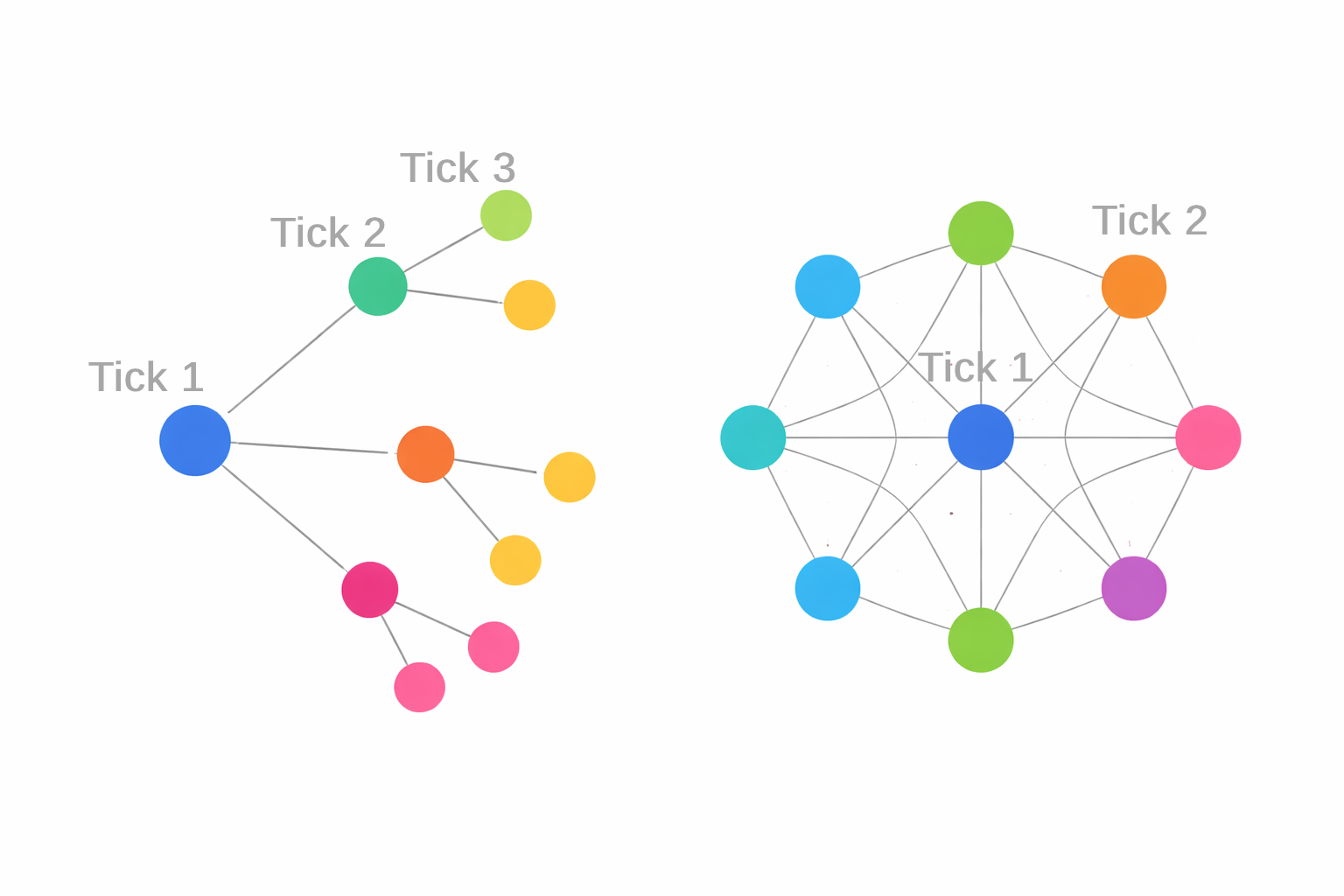
- Branching / Clustering Branching refers to the divergence of causal sequences across updates, while clustering denotes the subsequent formation of correlated structure within that divergence.
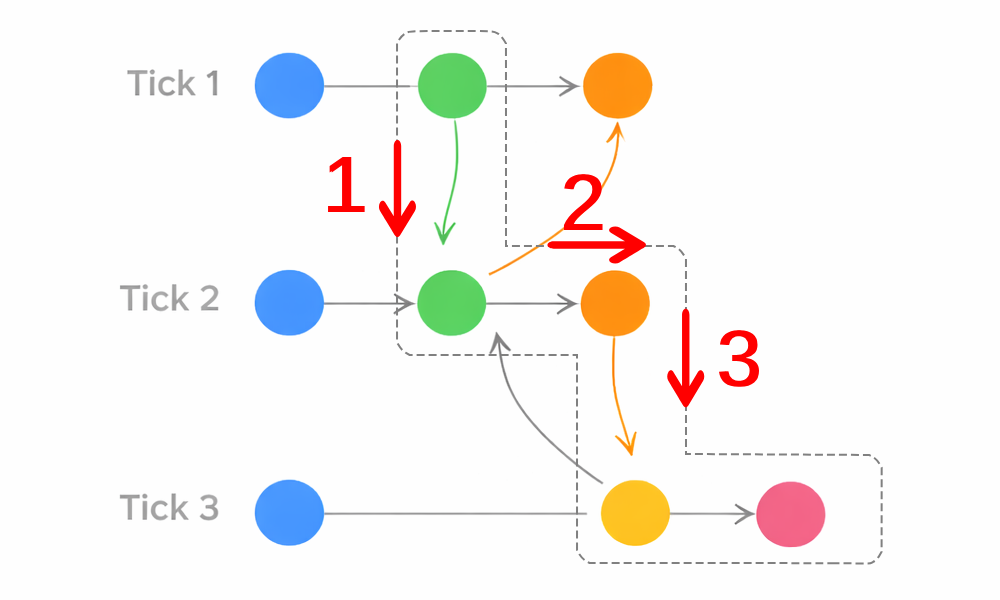
- Monotonicity Operational updates establish causal precedence through ordered dependency, without requiring an external time metric or a globally synchronous clock.
- Irreversibility Certain operational distinctions, once introduced, cannot be fully undone in subsequent updates.
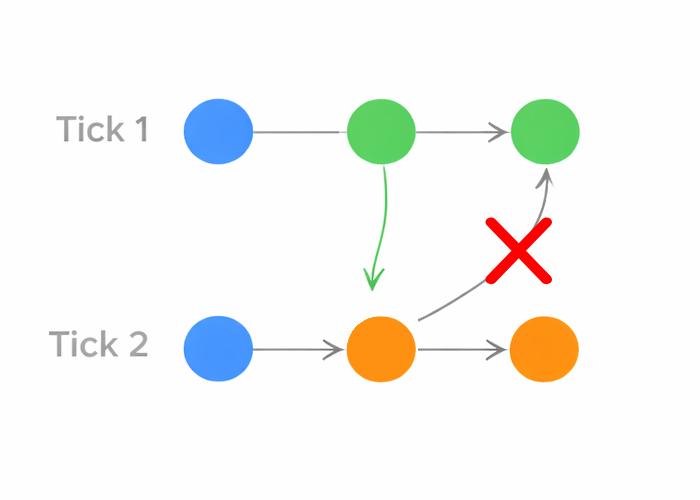
- Dependency constraints Higher-order structures arise only after the completion of prerequisite operational sequences.
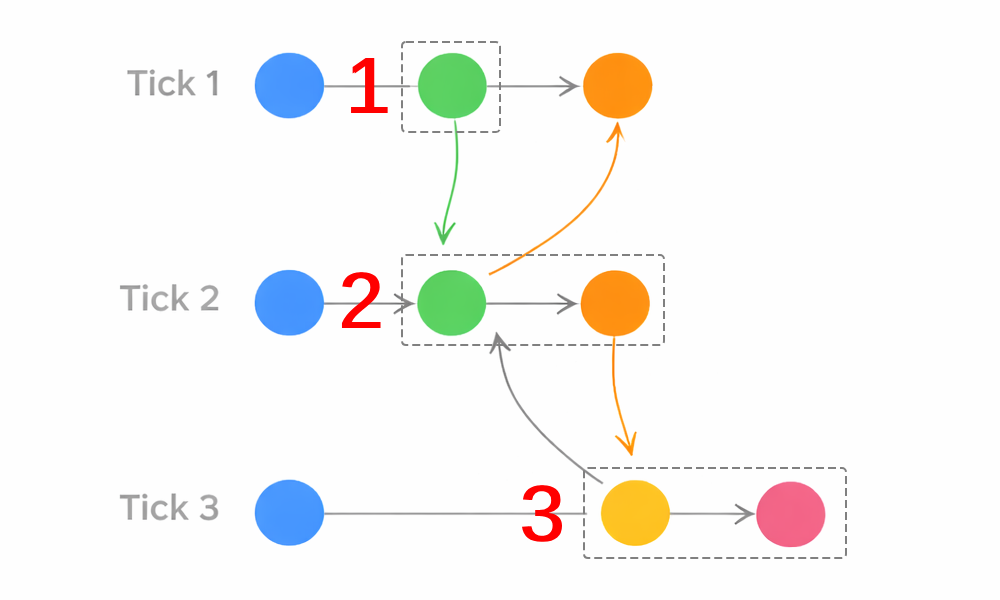
- Emergence principle Persistent structure arises when admissible distinctions stabilise through constraint-mediated commitment across repeated ticks.
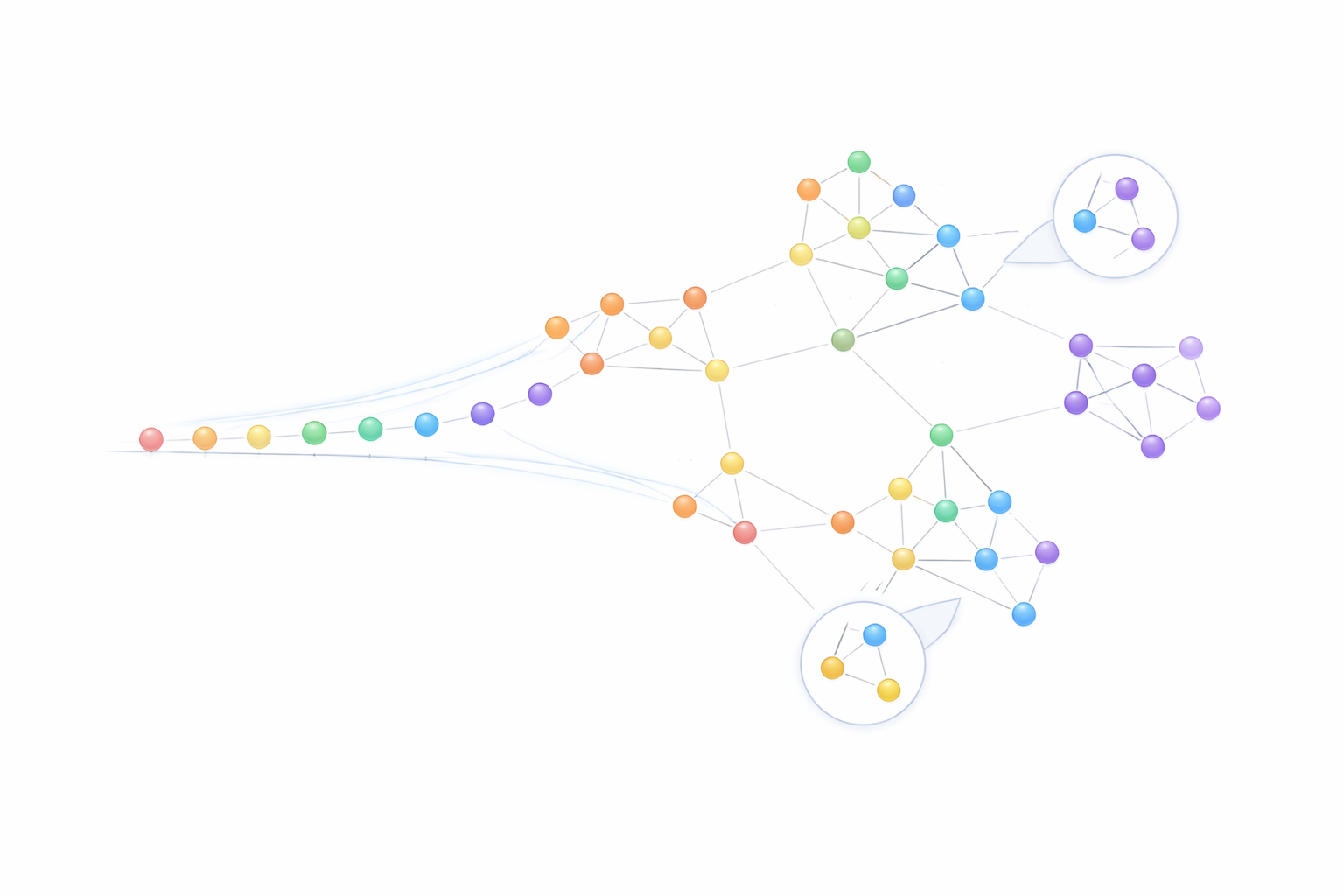
- Observer embedding Observers exist as subsystems within the dynamics and therefore access only emergent, relational notions of time. The underlying update ordering remains internal and unobservable.
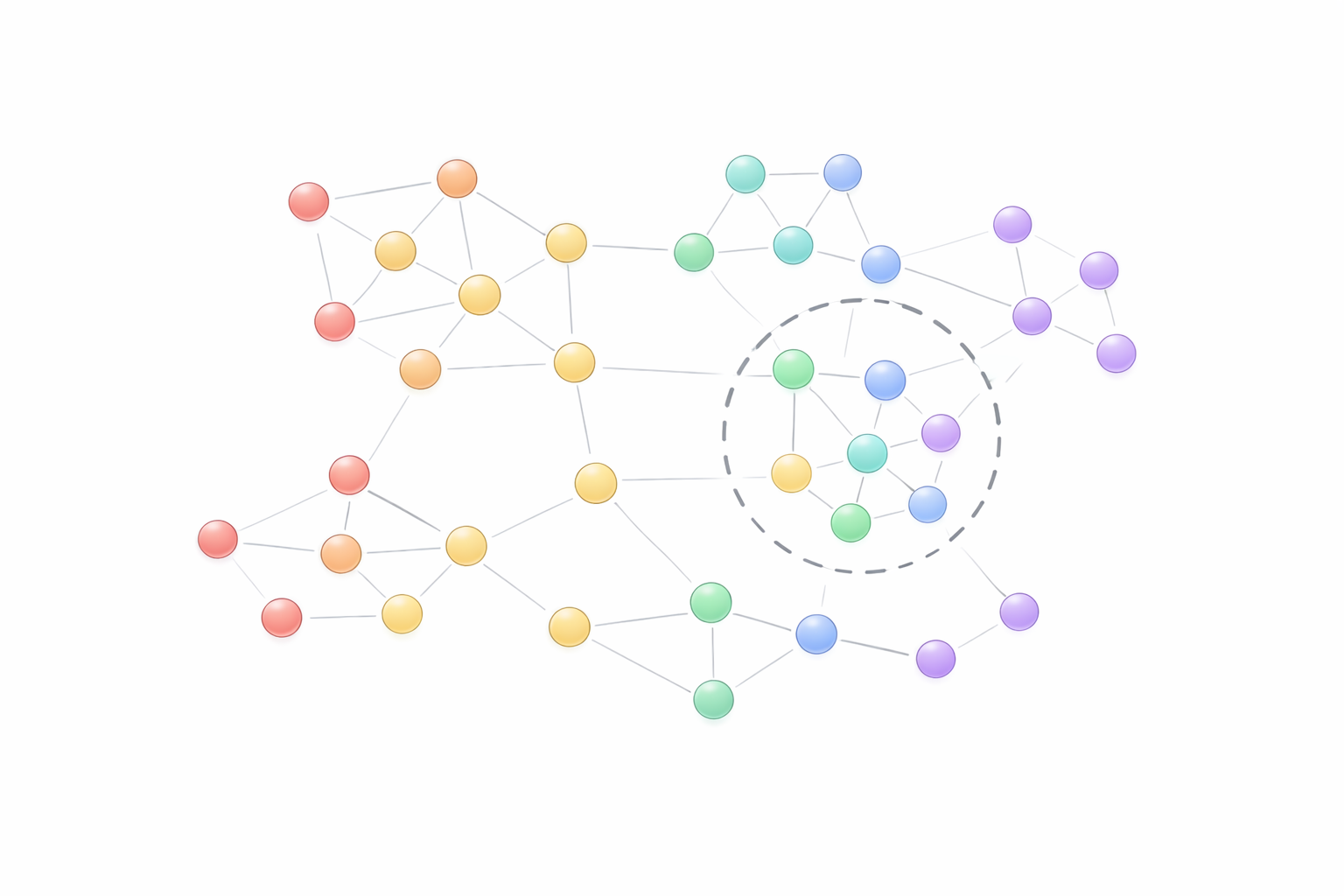
- Emergent time Embedded observers experience time primarily through the growth of causal depth and persistence, rather than through direct access to an external clock.
Degrees of Freedom
When this framework refers to degrees of freedom, it is not describing spatial dimensions, hidden axes of the universe, or directions one could move through. Instead, degrees of freedom are best understood as independent aspects of a single state.
A simple analogy is a single pixel on a screen. One pixel is not many pixels, and it does not exist in multiple dimensions. Yet it can still be described using several independent values at once: how bright it is, what colour it is, how saturated that colour appears, or whether it is active at all. These values do not represent separate spaces, they are different attributes of the same pixel.

In a similar way, the nine degrees of freedom in this framework can be thought of as nine descriptive table columns applied to a single operational state. Each degree of freedom captures a distinct mode by which a state may differ, persist, or influence subsequent updates. None of them alone defines the state, and none implies a separate dimension in which the system exists.
What matters is not the number of degrees of freedom, but the fact that they are independent yet co-present. Together, they describe how a state is structured, constrained, and able to evolve. The framework treats these degrees of freedom as operational descriptors and ways to characterise change, rather than as coordinates in a geometric space.
Nine Degrees of Freedom
Each Degree of Freedom denotes an independent register of operational state. These registers are not spatial dimensions or hidden axes, but distinct aspects through which a system may differ, stabilise, or influence subsequent updates.
Definitions are operational and do not presuppose semantic, cognitive, or physical interpretation.
Icons are mnemonic only and carry no ontological implication.
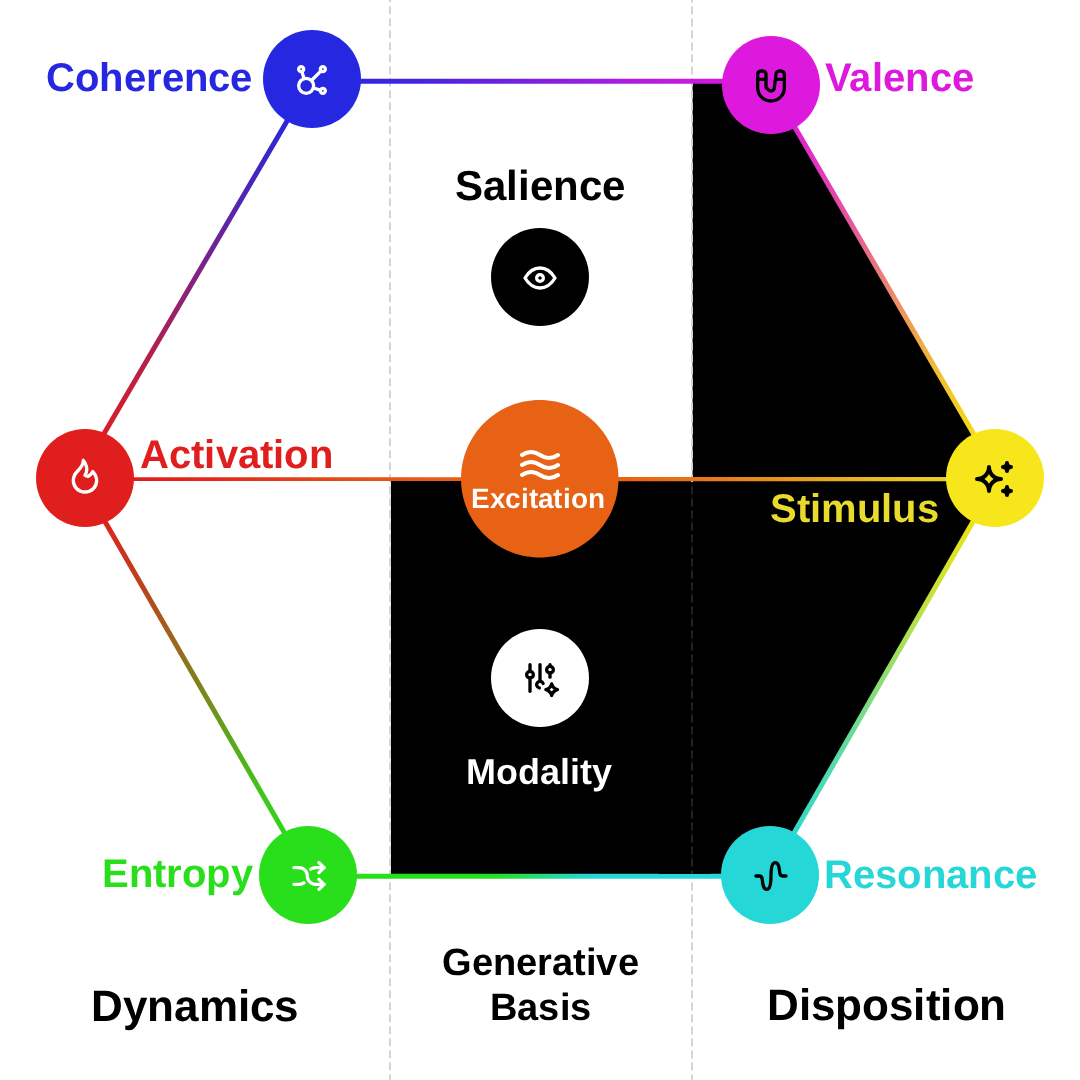
- CoherenceStructural alignment between participating distinctions. It contributes to the admissibility envelope governing stable configuration.
- EntropyStructured dispersion of possibility. It represents branching variation without implying disorder.
- ActivationMobilised engagement in transformation. It indicates operational readiness without implying direction or persistence.
- SalienceExpressive prominence within the system. It reflects relative weighting among co-present distinctions.
- ExcitationAvailable generative capacity. It enables participation but does not record structure.
- ModalityCategorical mode of expression. It characterises the representational form through which differentiation appears.
- StimulusPerturbation within an activated field. It introduces local disturbance without guaranteeing persistence.
- ValenceDirectional weighting across variation. It expresses attraction, repulsion, or preference within dispersion.
- ResonanceReinforcement across aligned structure. It reflects persistence of compatible patterns under repeated participation.
Diagrammatic Arrangement
- Opposite vertices denote complementary registers across subspaces.
- Excitation is shown centrally as conserved generative capacity.
- The black/white division indicates Dynamics and Disposition.
The Degrees of Freedom are arranged such that Dynamics and Disposition form complementary duals, represented geometrically as opposite vertices rather than edge-adjacent couplings.
Excitation is treated as a conserved capacity field underlying participation and is therefore represented centrally as a structural constraint rather than as a peripheral register.
Operational Subspaces
- Dynamics describes how change is locally expressed across operational updates. It governs mobilisation, variation, and relational restructuring under shared generative capacity.
- Disposition describes how expressed structure is differentially weighted across commitment history. It governs reinforcement, directional weighting, and persistence of configuration.
Both subspaces are jointly required. Dynamics enables transformation, Disposition conditions stabilisation. Excitation, Salience, and Modality together condition the enabling context for expression, a grouping later formalised as the Generative Basis.
Operational Transitions
The operations described in this framework are not actions performed by an agent, nor are they physical forces, particles, or mental processes. Instead, they are best understood as basic modes by which a system can change or remain stable as it updates from one state to the next. An operation, in this sense, is not something that does anything on its own. It is a way of describing how change is permitted, constrained, or expressed during an update. Multiple operational roles may be relevant within a single update, shaping the same transition from different perspectives.
A helpful way to think about the operations in this framework is to imagine a simple dial lock. From the outside, the lock appears to have only one visible control: a dial that can be turned freely. i.e. a single degree of freedom. The dial may pass over the same positions many times, and it can end on the same number through different sequences of turns. Yet whether the lock opens or remains closed depends not on the final position alone, but on the particular sequence of movements that led there. In this sense, the history of operations matters just as much as the apparent configuration.
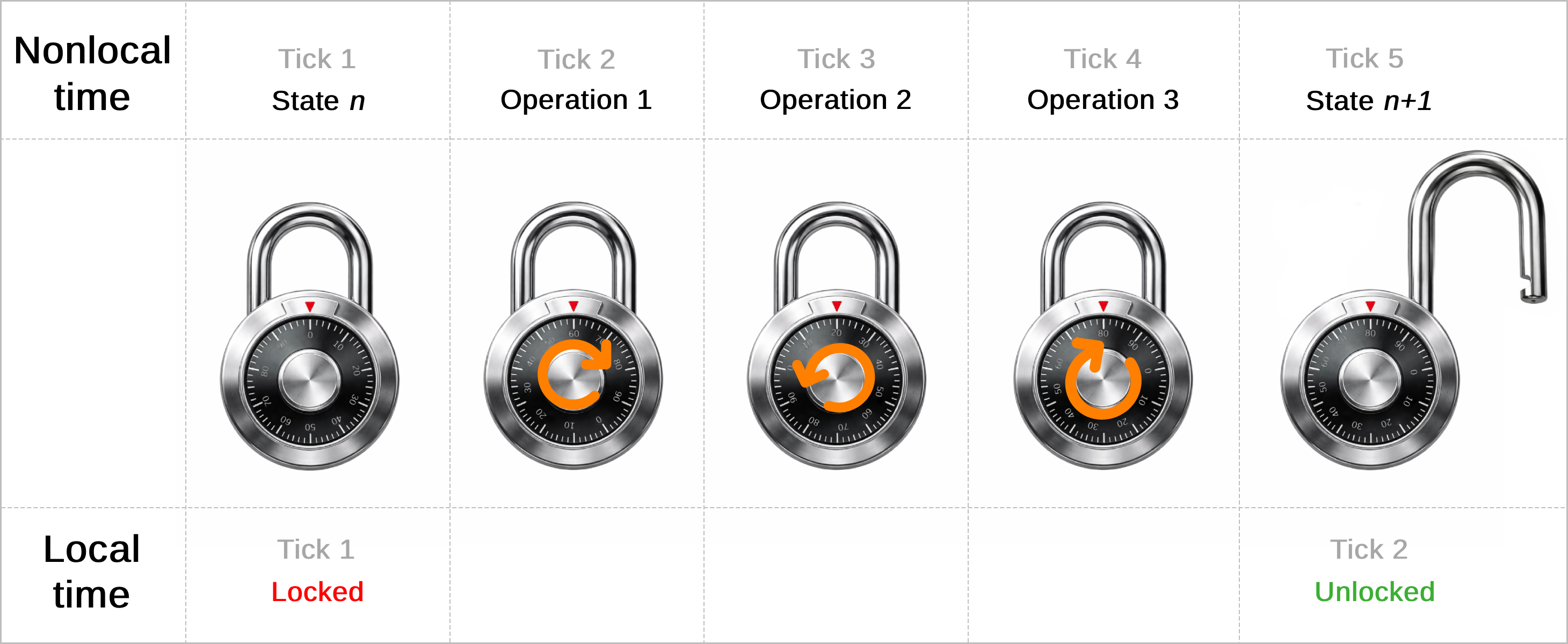
The operations described here do not determine outcomes in isolation; what matters is how they are applied, in what order, and how their effects accumulate across successive ticks. Configurations that appear identical may differ in their operational history, and this hidden structure can determine whether a transition is permitted or a stable identity can persist. Visual illustrations are therefore used throughout as intuitive guides, helping to distinguish operational sequence from final configuration rather than serving as literal models.
Operational Grammar and The Tick
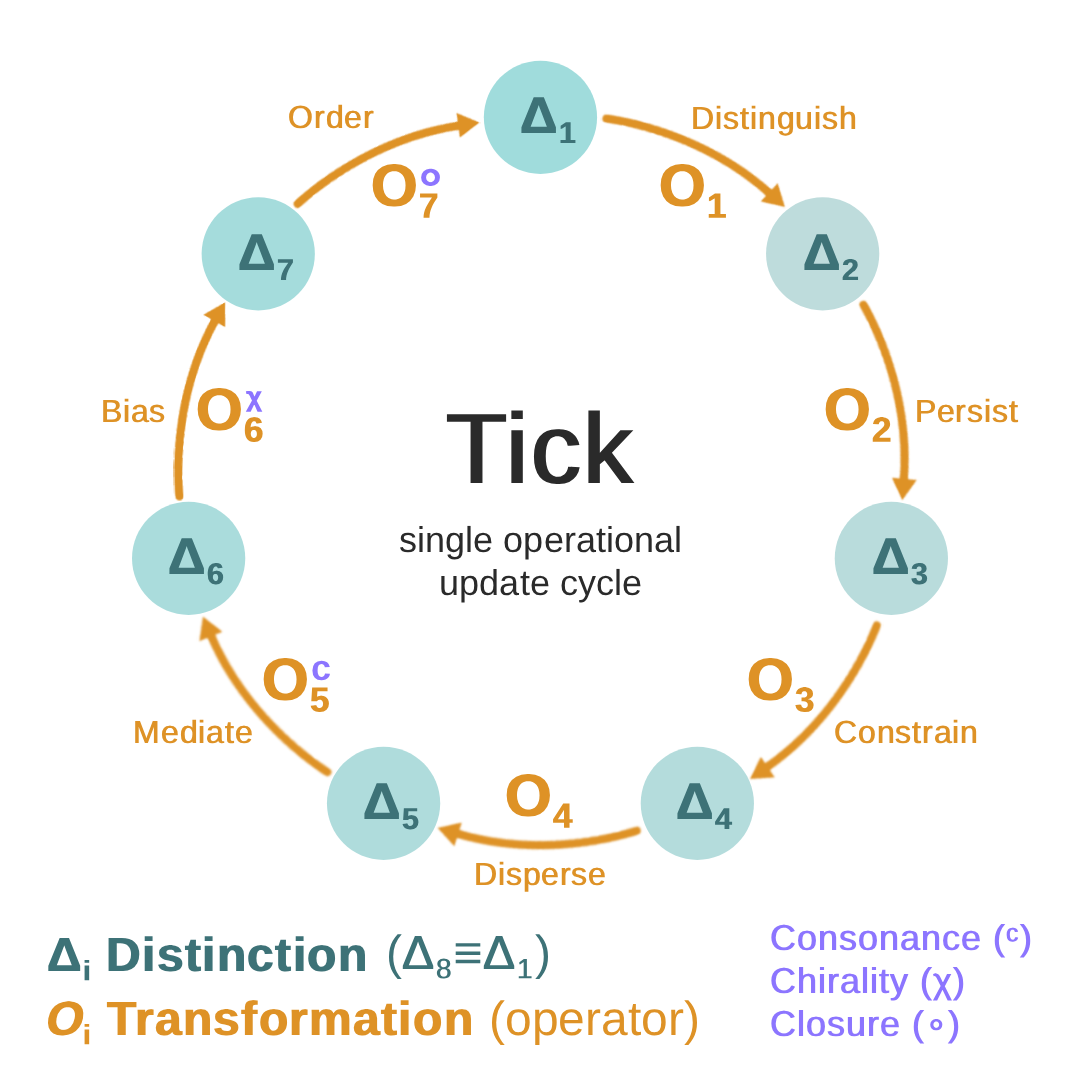
A Tick may be expressed formally as a directed traversal of operational transformations acting on distinctions. Rather than treating the seven operations as independent local steps, the framework represents each Tick as a single closed update cycle: an irreversible passage through admissible transformation and commitment.
In this representation:
- Distinctions appear as structural nodes, denoted
- Transformations (operational updates) appear as directed edges, denoted
The seven operations may therefore be written as operators:
A Tick is then captured as a minimal structural object:
with each transformation mapping one distinction into the next:
Cyclic indexing expresses closure of the operational traversal through modular identification, without introducing a privileged origin or implying reversibility. Irreversibility is carried globally by the directed orientation of the Tick.
Read, Gate, and Write
The operational grammar consists of three functional roles:
- ← Read: Degrees of Freedom referenced to determine admissibility.
- ↔ Gate: Degrees of Freedom constraining whether transformation may proceed.
- → Write: Degrees of Freedom in which realised transformation is committed.
These roles describe functional participation within a single irreversible update and do not denote temporal staging.
The Seven Operations
The seven operations constitute the minimal irreversible traversal through which commitment progresses across a Tick. Each operation assigns Degrees of Freedom to functional roles within a single closed update cycle.
O1 : Distinguish
Undifferentiated → distinguishable structure
Distinguish introduces operational differentiation. Available capacity is referenced, expressive prominence and representational mode constrain admissibility, and mobilisation with perturbation is written. No persistence is yet committed.
O2 : Persist
Transient difference → stable identity
Persist stabilises differentiated structure. Expressive prominence and mode are referenced, mobilisation constrains continuation, and structured dispersion with directional weighting is committed.
O3 : Constrain
Free variation → constrained relational structure
Constrain consolidates relational compatibility. Mobilised variation is referenced, dispersion constrains admissibility, and structural alignment with reinforcement is written.
O4 : Disperse
Local commitment → branching continuation
Disperse reintroduces generative motion within compatible bounds. Structured variation is referenced, alignment constrains admissibility, and renewed mobilisation is written.
O5ᶜ : Mediate
Isolated persistence → coupled dynamics
Mediate evaluates compatibility under Consonance (ᶜ). Structural alignment is jointly referenced, mobilisation constrains coupling, and directional structure is redistributed.
O6χ : Bias
Symmetric branching → orientational preference
Bias introduces directional preference under Chirality (χ). Mobilised trajectories are referenced, dispersion gates asymmetrically, and oriented relational structure is committed.
O7∘ : Order
Change → realised history
Order realises Closure (∘). Directional outcomes are referenced, compatibility constrains finality, and expressive prominence with representational form is committed to record. Closure records without amplifying, biasing, or re-evaluating.
Pyramidal Progression
The traversal forms a pyramidal progression:
- O1→O2→O3→O4 generative ascent
- O5ᶜ →O6χ compatibility alignment & directional asymmetry
- O7∘ structural closure
The operations do not represent temporal stages. They specify structured participation within an admissible transformation.
Structural Invariants
- Each Degree of Freedom progresses forward without inversion within a Tick.
- Consonance (ᶜ) appears only in Mediate (O5).
- Chirality (χ) appears only in Bias (O6).
- Closure (∘) appears only in Order (O7).
- Coherence and Resonance form the late-phase admissibility envelope.
- Salience and Modality receive committed record only under Closure.
- No operation simultaneously gates and writes the same register.
- The traversal is monotonic and irreversible.
Together, the seven operations constitute a minimal grammar through which emergence, directional asymmetry, and archival finality arise without presupposing external time or imposed geometry.
The Participation Ledger
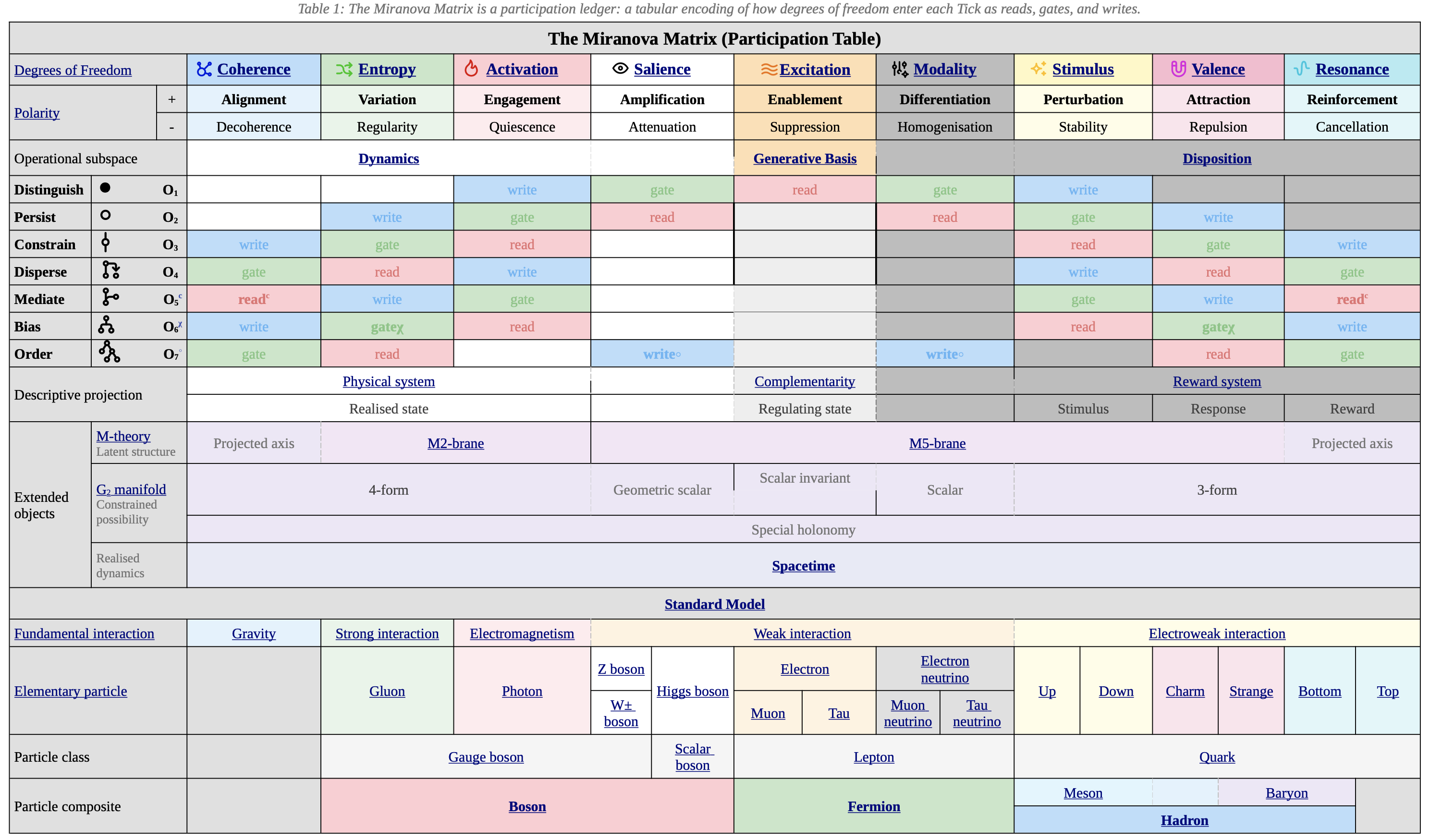
The Participation Ledger specifies how the Degrees of Freedom participate as reads, gates, and writes across each operator. It may therefore be understood as an operational record defined over the Tick skeleton above, summarising how commitment is structured through the seven operations.
How to Read the Participation Ledger
The Participation Ledger encodes role assignment of Degrees of Freedom across the seven operations.
- Rows correspond to operations.
- Columns correspond to Degrees of Freedom.
- Entries specify Read, Gate, or Write participation.
The ledger is read:
- Across a row, to observe structured participation within an operation.
- Down a column, to observe forward lifecycle progression across a Tick.
Excitation functions as conserved generative capacity and is referenced once as availability.
The Miranova Matrix (Participation Table)
Participation Table
Interpretation and Projection
This section provides an interpretive overview of how the components of the framework relate once the operational primitives are in place. No new mechanisms are introduced. Instead, the intent is to clarify how change becomes expressible, how it is conditioned, and how persistent structure can arise through repeated admissible commitment.
At a high level, the framework distinguishes between:
- Potential: the space of admissible configurations the system can support, defined by the full set of Degrees of Freedom.
- Generative Basis: the shared substrate that enables expression at all.
- Dynamics and Disposition: complementary operational subspaces describing how change is locally realised and how persistence is shaped across updates.
Generative Basis
While all nine Degrees of Freedom define the space of potential, Excitation, Salience, and Modality form a shared generative basis enabling structured expression without specifying its outcomes. Excitation functions as a conserved capacity field, while Salience and Modality characterise the prominence and representational mode through which expression occurs.
Dynamics and Disposition
- Dynamics describes how change is locally expressed across operational updates, operating over shared generative structure while remaining subject to global constraint.
- Disposition describes how expressed structure is differentially weighted across commitment history, biasing which identities or configurations tend to persist.
Neither subspace is sufficient in isolation. Together, they describe how expression and persistence arise from minimal operational participation under constraint, without presupposing external time or imposed geometry.
Operational Emergence
From the primitives defined above, several minimal structural phenomena follow naturally in simulation-oriented realisations:
- continuity of distinction across ticks (identity persistence)
- admissible branching chains (divergent commitment histories)
- record-holding structure through ordering (irreversible history)
- emergent subsystems capable of internal differentiation (“observers” in the abstract operational sense)
The purpose of these notes is to emphasise that structured entities and histories may arise directly from the update grammar, without requiring additional imposed mechanisms.
Geometric Projection (Octet Arrangement)
When multiple degrees of freedom must coexist under shared constraint, stable relational balances admit simple geometric projections. In Miranova, the Degrees of Freedom may be arranged in an octet-like symmetry: eight peripheral registers organised around a shared generative basis, with structured differentiation arising through admissibility, bias, and ordering.
Such octet projections are interpretive aids only. They do not introduce additional structure or assert physical correspondence, but serve as a compact map of relational balance within the operational space.
Matrix-Theoretic Context
BFSS Matrix Theory is referenced only as an example of a non-geometric substrate in which spacetime is not fundamental. The Miranova framework does not depend on BFSS dynamics, nor does it claim derivation from brane constructions. Any labels or projections along such axes are intended solely as descriptive analogies for operational roles, not as assertions of novel physics.
Outlook Toward Simulation
The interpretive alignments above are descriptive only. The framework itself remains fully specified by its Degrees of Freedom, Tick primitive, and participation roles. With this operational core established, we now turn to simulation realisation: admissibility rules, gate families, excitation fields, and event-driven traversal mechanisms through which the Participation Ledger may be explored computationally.
Simulation Realisation
The Miranova Matrix is defined as an operational participation ledger: a minimal grammar specifying how Degrees of Freedom are read, gated, and written across update cycles. This structure is intended to be directly implementable in computational settings. The purpose of simulation is therefore not to add further primitives, but to explore what forms of persistent organisation arise when the ledger is enacted as an update process.
Simulation realisations proceed by specifying:
- an update traversal scheme,
- admissibility and gate instantiations, and
- capacity fields and boundary conditions under which commitment propagates.
Commitment Traversal
A key requirement is that commitment need not occur through synchronous global stepping. A fully synchronised “tick clock” implicitly introduces a preferred frame. Instead, updates may be realised as an asynchronous event-driven traversal, where simultaneity is not fundamental and ordering is local rather than global.
On this view, the Tick functions as a ledger abstraction: the invariant object is not a universal step index, but the local admissibility of commitment across the Participation Ledger.
Strain-Driven Scheduling
Update selection need not be random or externally forced. Commitment may instead be prioritised by unrealised compatibility pressure, or strain, defined as:
where denotes salience or mobilisation demand, and denotes consonance (compatibility weight). Event priority may then be expressed as:
Under this rule, updates occur preferentially where demand is high, consonance is low, and capacity remains available. Commitment therefore propagates as causal ripple structure through regions of maximal tension, without requiring stochastic noise injection.
Excitation as Capacity Field
Excitation is treated as a globally conserved capacity for expression rather than a repeatedly prescribed operand. In simple spatialised realisations, excitation may be modelled as a monotone availability field, for example as an inverse power-law capacity profile:
Importantly, halo-like stability bands need not be imposed. Instead, persistent organisation may emerge in intermediate regions where excitation capacity and admissibility jointly balance. Inner regions may become incompatible under strain, while outer regions lack mobilisation strength, producing annular stabilisation as an emergent consequence of the operational rules.
The specific functional form is not essential; any smooth monotone decay may serve, with halo stabilisation emerging from admissibility balance rather than being imposed.
Topology and Flux
To sustain ongoing dynamics without external injection, simulations may adopt periodic or toroidal boundary conditions. Such topology permits conserved circulation modes, supporting persistent traversal without requiring randomness. Flux direction may be treated as an initial symmetry-breaking condition, while ordered persistence may be committed downstream through Bias and Ordering.
Closed damping cases may instead settle into quiescence, while toroidal regimes admit ongoing “everness” through conserved operational circulation.
Gate Families
The abstract Read/Gate/Write grammar does not prescribe a single functional gate form. Rather, gating may be instantiated through a family of admissibility operators, such as:
- threshold constraints (hard admissibility)
- graded compatibility kernels (soft admissibility)
- tension minimisation rules
- entropy/coherence trade-off filters
- chirality-selective bias gates
These variants do not alter the Participation Ledger itself, but provide implementational degrees of freedom through which different simulation regimes may be explored. Specific gate instantiations are left open, forming a natural axis of future simulation refinement.
Emergent Signatures
Because the framework is operationally specified, it suggests several qualitative signatures that should arise under broad initial conditions:
- robustness under asynchronous traversal (no preferred global tick frame)
- strain-front propagation rather than uniform updating
- halo-band stabilisation under monotone excitation fields
- chirality domain persistence once bias is introduced
- topology-sustained circulation under periodic boundary conditions
Such behaviours provide simulation-facing expectations through which the operational grammar may be refined and empirically constrained.
Toward Implementation
Simulation therefore functions as the next step of the framework: enacting the Participation Ledger as an event-driven commitment process. With admissibility rules, capacity fields, and gate instantiations specified, the Miranova Matrix becomes a computational object through which emergent structure, persistence, and constraint propagation may be systematically studied.
Structural Consequences
Within this operational setting, several structural consequences follow:
- causal depth provides an emergent basis for experienced time
- branching commitment supports rapid growth of complexity
- iterated admissible updates may generate ripple-like propagating structure
Concluding Context
The operational primitives and principles presented here define a minimal framework for reasoning about emergent structure, causal depth, and experienced time without presupposing spacetime geometry. By treating ordered operational updates as primary, the framework provides a coherent lens through which persistence, branching, and observer-embedded structure may arise from simple, irreversible processes.
Although developed at an abstract operational level, this framework is placed in dialogue with matrix-based approaches to fundamental physics, such as BFSS Matrix Theory, in which spacetime is likewise understood as emergent rather than fundamental. In this context, the Miranova Matrix does not propose any modifications to BFSS dynamics, nor does it attempt to derive physical observables. Instead, it offers a complementary conceptual vocabulary for articulating how ordered updates, causal depth, and interpretability may underwrite emergent temporal and structural features within matrix formulations.
The framework is intentionally limited in scope and generative in character. Its purpose is not to replace existing physical models, but to clarify relationships between causality, emergence, and embedded observation in systems where spacetime is not assumed. Further exploration may examine how such operational descriptions relate to specific matrix dynamics, physical observables, or computational implementations.
In this sense, the Miranova Matrix is offered as a structural lens rather than a completed theory, and its continuation, whether through formalisation, reinterpretation, or application, is left open to the broader community.
Open Questions
The framework is intentionally limited in scope. In particular:
- Absolute tick count may not be inferred from within the system.
- The behaviour of multiple clocks, extreme self-reference, and deep branching regimes is left undefined.
- Future work may explore connections to physical observables, dynamical models, or computational implementations.
Definitions
- Miranova · Combines Mira, the binary star system Mira A and Mira B, characterised by long-period variability and coupled stellar dynamics. With nova, in the sense of supernova, denoting large-scale emergent transformation arising from accumulated structure. The name reflects a framework concerned with variability, coupling, and the emergence of new structure from underlying relational dynamics, rather than the introduction of new fundamental physical law.
Acknowledgements
- This work has progressed beyond the documentation above. Please refer to The Commons for a concrete implementation that demonstrates the above concepts in more detail, and is also hopefully a bit more straight forward in my own words.
- This work was developed by the author. Generative AI tools were used selectively to assist with language refinement and the creation of some illustrative figures. Conceptual content, structure, and interpretation are the author's own.
Authored by Claire Mira Shaw.
